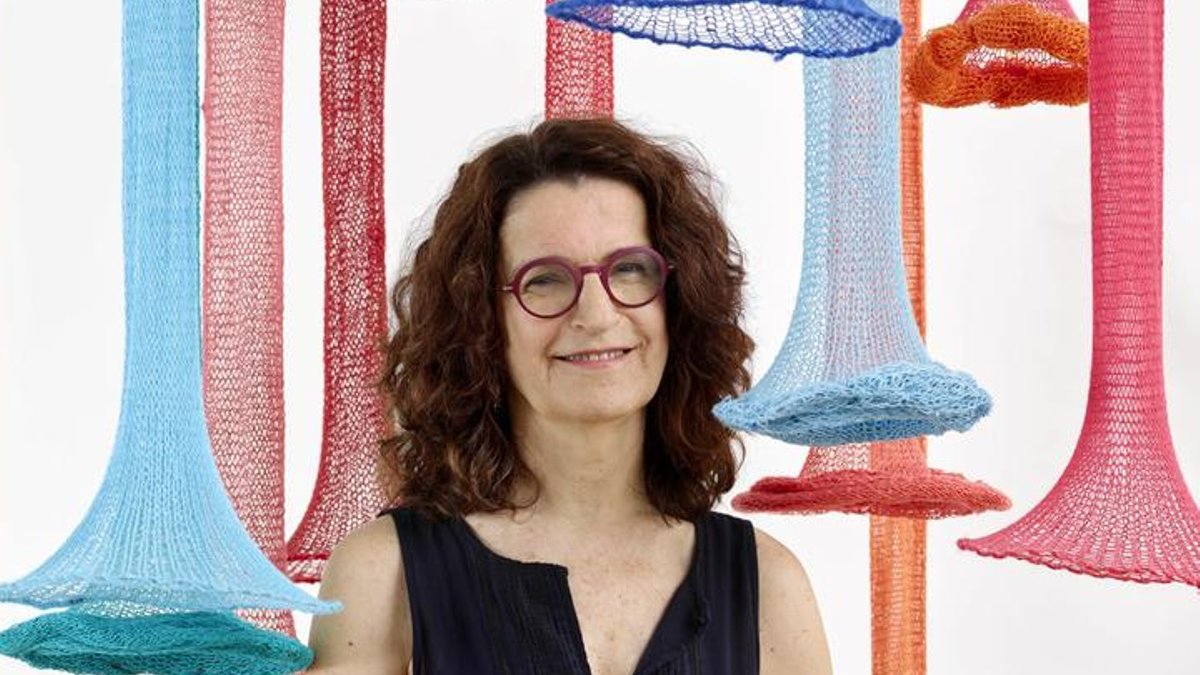
Miami’s textile art scene lost one of its defining voices last month when Uruguayan-born artist Evelyn W. Politzer (1961–2026) passed away. She abandoned a law career to study at Parsons School of Design in New York and later worked on her thesis for an MFA in Visual Arts.
Her work often balanced playfulness with ecological depth. Pieces ranged from abstract cartographies to large-scale installations, displayed in airports, botanical gardens, and galleries across Florida. At the time of her death, her art appeared at the Deering Estate, the Aluna Art Foundation, and the Florida Craft Art Gallery in St. Petersburg.
The Threads That Bound a Community
In 2020, during the pandemic, Politzer co-founded the Fiber Artists Miami Association (FAMA) with Aurora Molina and Alina Rodríguez Rojo. The collective now counts 350 members. While largely driven by women, men like Marco Caridad, artistic director of the Miami International Fine Arts venue (MIFA), also became key figures.
Related: Understanding Tattoo Recovery: The Healing Journey
Her husband, Gabriel Politzer, played a steady role in the group’s expansion. Molina described his generosity as a constant force behind FAMA’s growth. The association will now direct donations made in her memory toward a scholarship in her name, supporting students pursuing textile fiber projects.
This fall, FAMA will launch its first Textile Art Triennial at MIFA, where the Evelyn Politzer Prize will be awarded. Both initiatives reflect her belief that art should do more than decorate—it should provoke care for the Earth and for one another.
Her work often blurred the personal and the universal. Nature’s Map (2020), a hand-dyed wool piece, imagined a place where colors converged like paths leading back to the elements. It was the first in a series of “poetic maps” that framed nature as a living, fragile entity.
A Language of Wool and Water
Politzer grew up in Uruguay, where sheep outnumbered people. Wool drying in the sun became a sensory memory that resurfaced in her work. She forged an alliance between the greens and ochres of the earth and the intense reds, yellows, and blues of uncarted wool, or of fibers resistant to sun and rain, designed to hang from trees.
Related: Charming Chislehurst: Unveiling London’s Engagement Ring Trends
Her Nidos series (2016–2021) is currently on display in the interior garden of the Tower Hotel in Little Havana as part of Aluna Art Foundation’s Endangered and Unseen exhibition. When a stray cat named Botero—so dubbed by local artists for his size—claimed one of the red nests as his perch, she declared him the only cat to own a work of art. The moment captured her spirit, blending whimsy with deep respect.
In lieu of flowers, her family asked mourners to donate to the Jewish National Fund for water solutions or tree-planting initiatives, or to FAMA. The requests reflected her life’s work—using art as a bridge between people and the planet.
For those who knew her, Politzer’s legacy lies not just in the wool and thread she left behind but in the communities she stitched together. Her influence remains visible in Miami’s textile scene, where her vision of art as both personal expression and collective action endures.

